Valentine's Day Counting Game Math Game: A Playful Path to Numeracy
Engaging Students Through Seasonal Math Activities
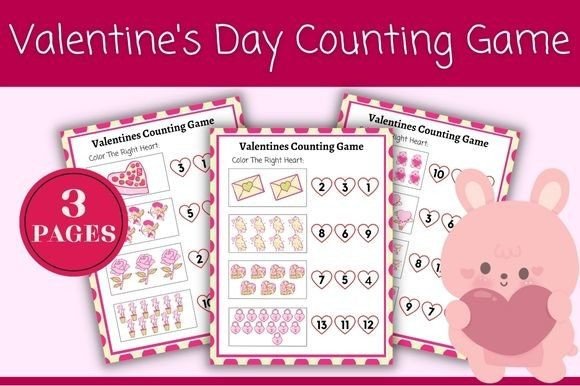
Math doesn't have to be dry or intimidating. By incorporating seasonal themes like Valentine's Day, educators and parents can turn foundational math practice into a joyful experience. The Valentine's Day Counting Game Math Game is a prime example of how thematic learning can enhance engagement and retention. Designed for early learners, this printable resource uses holiday visuals and interactive elements to teach number recognition, sequencing, and one-to-one correspondence.
The game comes in PDF format, making it easy to download and print. Each set includes three sheets sized at 8.5 x 11 inches — perfect for standard printers and classroom handouts. The flexibility to print once or multiple times allows for repeated practice, which is essential for mastery in early math skills.
How the Valentine's Day Counting Game Works
Each sheet in the Valentine's Day Counting Game Math Game presents a series of themed images — hearts, candies, or love notes — arranged in patterns or scattered formations. Students are prompted to count each set and write the correct number in the space provided. Some sheets may ask them to match quantities with numerals or fill in missing numbers in a sequence.
- Visual prompts include hearts, chocolates, and other Valentine’s symbols
- Numbers typically range from 1 to 20, depending on the sheet
- Instructions are simple and intuitive for young learners
This approach encourages students to connect abstract numbers with real-world quantities. It also helps them develop fine motor skills as they write numbers and interact with the page.
Why Seasonal Math Games Matter
Themed educational tools like the Valentine's Day Counting Game Math Game are more than just festive distractions. They tap into children's natural curiosity about holidays and special events, making learning feel relevant and exciting. When students are emotionally engaged, they're more likely to retain information and apply it in different contexts.
Moreover, seasonal games can be reused year after year, offering a cost-effective and sustainable option for educators and homeschoolers. Since the sheets are in PDF format, they can also be used digitally on tablets or interactive whiteboards, adapting to modern classroom environments.
Who Benefits from the Valentine's Day Counting Game?
This math game is ideal for a variety of users:
- Classroom teachers looking for holiday-themed activities that align with math standards
- Homeschool parents who want structured but fun math practice for their children
- Tutors seeking supplemental materials to reinforce counting skills
- After-school program coordinators in need of engaging group activities
Its versatility makes it suitable for both individual and group settings. Teachers can use it as a warm-up exercise, a center activity, or even as homework during the Valentine’s season.
Maximizing Educational Value
To get the most out of the Valentine's Day Counting Game Math Game, consider incorporating it into a broader lesson plan. For example:
- Pair counting exercises with sorting activities using the same symbols
- Use the sheets as a springboard for discussions about patterns or comparisons
- Encourage students to create their own counting problems using holiday-themed drawings
These extensions help reinforce number sense while promoting creativity and critical thinking.
Practical Tips for Implementation
Here’s how to make the most of this downloadable resource:
- Print on cardstock for durability if you plan to reuse the sheets
- Laminate the pages and use dry-erase markers for interactive use
- Pair with manipulatives like heart-shaped counters or buttons for hands-on learning
- Include in a math center with other seasonal games for variety
These strategies not only enhance the learning experience but also allow for differentiation based on student needs and abilities.
Accessibility and Inclusivity
One of the advantages of the Valentine's Day Counting Game Math Game is its accessibility. Since it’s in PDF format, it can be easily shared with parents or used in remote learning environments. It can also be adapted for students with learning differences by adding audio instructions or using assistive technologies.
For students who struggle with writing, educators can modify the game by allowing them to circle or point to the correct number instead of writing it. This flexibility ensures that all students can participate meaningfully.
Real-World Relevance of Early Counting Skills
Counting is more than a school activity — it's a life skill. Children encounter numbers daily, whether they're counting steps, toys, or snacks. The Valentine's Day Counting Game Math Game reinforces this real-world application by presenting numbers in a context that's both familiar and appealing.
By practicing with themed visuals, students begin to see math as a part of their everyday experiences. This understanding lays the groundwork for more advanced mathematical thinking in later years.
Measuring Progress with the Game
While the game is designed to be fun, it also serves as a subtle assessment tool. Teachers and parents can observe how students approach counting tasks — do they count each item one by one? Do they skip numbers or recount? These observations provide insight into a child's number sense and can guide future instruction.
Because the sheets are printable and reusable, they allow for progress tracking over time. Comparing early attempts with later ones can show growth in both accuracy and confidence.
Final Thoughts
The Valentine's Day Counting Game Math Game is more than a seasonal worksheet — it's a versatile, engaging tool that supports early math development. By combining thematic design with educational rigor, it offers a unique way to build foundational skills without sacrificing enjoyment.
Whether used in a traditional classroom, a homeschool setting, or as a supplemental activity, this math game demonstrates how thoughtful design can transform basic learning into a memorable experience. And with its simple format and easy accessibility, it’s a resource that educators and parents can rely on year after year.